PU Thinner Manufacturing in India: From Raw Materials to Application-Ready Formulations

Polyurethane-based coatings have secured their place in furniture finishing, auto body painting, wood coatings, and industrial paint due to their exceptional wear resistance and gloss-retention characteristics upon curing. However, the quality of PU thinner used during the process determines the final outcome to a great extent. The working consistency, drying mechanism, and film formation abilities are governed by the characteristics of thinners used during the process. The PU Thinner manufacturers India must understand the nuances of producing the ideal formulation for the target applications to meet the performance benchmarks.
Understanding the Role of PU Thinner
A polyurethane thinner is a critical component that helps determine the nature of paint films formed during the curing process. Apart from affecting film formation, thinners influence the working consistency and drying characteristics of the applied paint. A thinner with inappropriate characteristics for a given application will lead to poor film formation, hence defeating the purpose of using polyurethane-based paint systems. This indicates the importance of formulation in determining the characteristics of a thinner, which must be done with precision at the manufacturing stage.
Raw Materials Used in PU Thinner Formulation
A typical PU thinner consists of a mixture of solvents in specific ratios to achieve the desired characteristics. Evaporation rate, solvency, and volatility are the crucial attributes considered at this stage, as indicated by the evaporation rate curve. This is necessary to ensure that the rate of solvent escape from the paint film is appropriate for the intended application. A suitable combination of fast, medium, and slow evaporating solvents can be selected to meet the requirements.
The following types of solvents can be used in varying ratios to obtain the desired characteristics:
- Esters and ketones: These solvents are characterized by excellent solvency for polyurethane resins, making them ideal for use in thinners.
- Aromatic hydrocarbons: These solvents offer good solvency and contribute to the evaporation rate and curve.
- Alcohols: They are primarily used to promote good flow characteristics of the paint film and reduce the risk of blushing.
- Glycol ethers: These solvents have low evaporation rates and are primarily used in the production of slow-drying thinners.
The specific ratios depend on the intended application for the thinner, with consideration of the required evaporation rate.
Evaporation Rate Balancing
The evaporation rate of a given thinner determines the formation of the paint film, as indicated by the evaporation rate curve. In general, there are three distinct stages, namely; fast, medium, and slow. The characteristics of the solvent dictate the stage that it will occupy. In essence, fast evaporating solvents are primarily responsible for ensuring that the surface of the paint film loses its tack to allow for the next coats or topcoating. Medium evaporating solvents dictate the workability and leveling of the paint film, whereas slow evaporating solvents affect the overall curing time of the film. The relative percentage of each solvent type will determine the overall evaporation rate of the resulting thinner.
It is also necessary to consider the location where the produced thinner will be used. This is determined by a number of factors, including but not limited to the local atmospheric humidity and temperature. As a result, local variations must be taken into account when selecting the solvents and their ratios to fit a specific location.
Manufacturing Process: From Blending to Quality Control
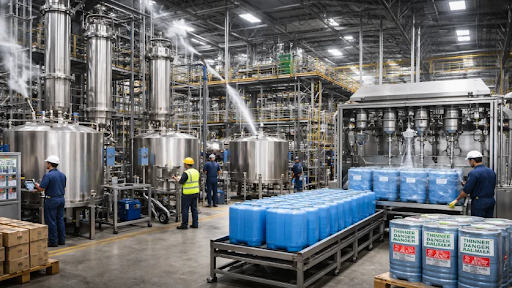
The manufacturing process involves a number of steps, starting with the procurement of raw materials and concluding with quality tests before packaging. It is vital to ensure that only high-quality solvents free from contaminants are used in the production process. This is because impurities present in the solvents will affect the overall evaporation rate of the resulting thinner. After screening and verification against a set of specifications, solvents are mixed in the specified ratios to form a preliminary formulation. During this stage, it is vital to ensure proper sequencing of mixing as it affects the dissolution characteristics of the resulting thinner. The mixture is then subjected to additional processing to obtain a final formulation. This usually involves:
- Viscosity and flash point testing, particularly for thinners intended for specific applications.
- Testing against a given paint system to ensure compatibility as defined by the appearance and level of gloss.
- Storage stability evaluation, particularly against the effects of aging.
After these tests have been passed, the batch undergoes filling and packaging after evaluating the effects of storage conditions on the product.
Variation in Formulations
It is paramount to highlight that not all PU thinners are the same, with different applications and painting methods requiring different thinner types. For instance, a thinner intended for spray application has different characteristics from one designed for use with brushes or rollers. Similarly, brush or roller application thinners can be formulated differently for use in varying relative humidity conditions. Another factor to consider when selecting the type of thinner is the intended method of solvent evaporation. These formulations are designed to meet the requirements of specific painting systems.
It goes without saying that formulating thinners requires a comprehensive understanding of their characteristics and behavior for targeted applications. This plays a critical role in distinguishing reliable thinner manufacturers from those selling substandard products.
Quality Consistency Across Batches
Quality consistency among batches is probably as important as the initial quality. After all, thinner that performs well in the first few batches but runs differently in the second can make painters’ lives miserable in the same way that differing viscosity or drying times can undermine work well tuned to a certain process.
Consistency in the materials, the production process, and the measurements and tests done according to a specification sheet determine it, and the experience of the manufacturers involved plays a part as well. Thus, Vastani Chemicals, as well as several other established companies that operate in this space, have better-organized production processes and hence can offer thinner with less variance from batch to batch, reducing the amount of guesswork needed by painters.
Storage, Handling, and Shelf Life Considerations
Even a properly formulated thinner may exhibit undesirable properties if it is not stored correctly before use. A mixture of solvents is a highly temperature-sensitive material that is particularly vulnerable to temperature changes and moisture. Moreover, the evaporation of a thinner’s more volatile components may occur when a can is left unsealed for too long.
Therefore, such solutions must always be stored in a cool and dry place and away from any heat sources. In addition, if the thinner has been only partially used, a seal has to be re-established right away, as the exposure to air changes the solvent ratio, thus altering a thinner’s properties.
It is also essential to adhere to the shelf life recommended by the manufacturer, which is especially crucial for thinners with glycols or alcohol due to their enhanced susceptibility to aging.
Final Remarks
The production of thinners involves intricate processes aimed at balancing a number of characteristics, including evaporation rate, solvency, working consistency, and more. As the article indicates, PU Thinner manufacturers India must consider a number of aspects when producing thinners for specific applications and painting methods. Understanding this process is vital for paint shops and applicators looking to select the most appropriate option for a given project.