Agentic AI Systems in SDLC: Autonomous Decision-Making in Software


If you’ve spent enough years inside real software teams—shipping late, fixing regressions at 2 a.m., arguing over scope creep—you eventually realize something uncomfortable: most of our development pain isn’t about writing code. It’s about decision-making at scale.
That’s where Agentic AI in software development starts to matter. Not as a shiny tool. Not as another “AI-powered” badge. But as a different way software systems decide, act, and adapt across the SDLC.
I’ll be direct: Agentic AI isn’t for teams looking to automate one step faster. It’s for teams ready to rethink how work flows through engineering.
TL;DR (For Busy Engineering Leaders)
- Agentic AI goes beyond generation—it plans, decides, executes, and corrects
- It works across the full SDLC, not isolated tasks
- Multi-agent systems behave more like junior engineers than tools
- Biggest value shows up in CI/CD, testing, and production reliability
- Without governance, it can create chaos faster than humans ever could
What “Agentic” Actually Means in Software Development
Let’s clear up confusion early.
Agentic AI isn’t just generative AI with extra steps. And it’s not traditional automation with smarter rules.
An agentic system has three defining traits:
- It understands goals, not just prompts
- It decides what actions to take
- It learns from the consequences of those actions
That combination changes how software work gets done.
In practical terms, an agent doesn’t wait for you to ask:
“Generate tests for this module.”
It sees rising defect rates, connects them to recent changes, and decides testing depth needs to increase—then does something about it.
That’s a very different mindset.
Agentic AI vs Traditional AI vs Generative AI (From the Trenches)
Here’s how this plays out in real engineering environments:
| Reality Check | Traditional AI | Generative AI | Agentic AI |
| Who decides the next step | Human | Human | System |
| Handles ambiguity | Poorly | Somewhat | Surprisingly well |
| Owns outcomes | No | No | Yes |
| SDLC reach | Narrow | Partial | End-to-end |
Generative AI helps you move faster on a task.
Agentic AI enables the system to move more efficiently between tasks.
That distinction is subtle, but it’s everything.
The Real Power: Goal-Driven Development
In most teams, goals get lost somewhere between Jira tickets and CI pipelines.
Agentic AI flips that.
You don’t give it instructions like a script. You give it intent:
- Reduce failed deployments
- Improve release confidence
- Cut regression cycles
From there, agents figure out:
- What needs to change
- Where to intervene
- When to escalate to humans
That’s why people describe it as “autonomous AI software development.” The autonomy is real—but only when designed correctly.
How Agentic AI Actually Works Across the SDLC
Requirements: Where Most Projects Quietly Break
Anyone who’s worked in delivery knows this phase is messy.
Agentic systems analyze:
- Stakeholder inputs
- Historical scope changes
- Downstream impact patterns
They don’t just document requirements. They challenge them. Flag contradictions. Reorder priorities based on risk instead of politics.
That alone saves weeks later.
Architecture & Design: Less Guessing, More Evidence
Design reviews are often opinion-heavy. Agentic AI introduces something teams rarely have: memory.
Agents evaluate designs against:
- Past incidents
- Scalability data
- Cost and performance constraints
They don’t replace architects. They force better conversations—and expose risky decisions early.
Development: Coordination Beats Speed
Here’s the honest truth: code generation is the least interesting part.
Where Agentic AI shines is coordination:
- Managing changes across repositories
- Preventing architectural drift
- Refactoring when complexity crosses thresholds
It’s like having someone who never forgets why a system was built a certain way.
Testing: From Coverage to Confidence
Most teams chase coverage metrics. Agents chase failure patterns.
Agentic AI:
- Creates tests based on real system behavior
- Detects flaky tests before humans notice
- Links failures to likely root causes
Testing stops being a gate and becomes a continuous signal.
CI/CD: Pipelines That Think
This is where the impact becomes visible.
Instead of static rules:
- Agents decide when to deploy
- Predict blast radius
- Roll back before customers complain
This isn’t “AI-assisted DevOps.” It’s decision-driven delivery.
Production: Self-Healing, Not Self-Ignoring
Production incidents don’t disappear. But response changes.
Agentic systems:
- Correlate logs, traces, and metrics
- Trigger fixes automatically
- Learn from every incident
The result isn’t zero outages. It’s fewer surprises.
What the Architecture Looks Like (At a High Level)
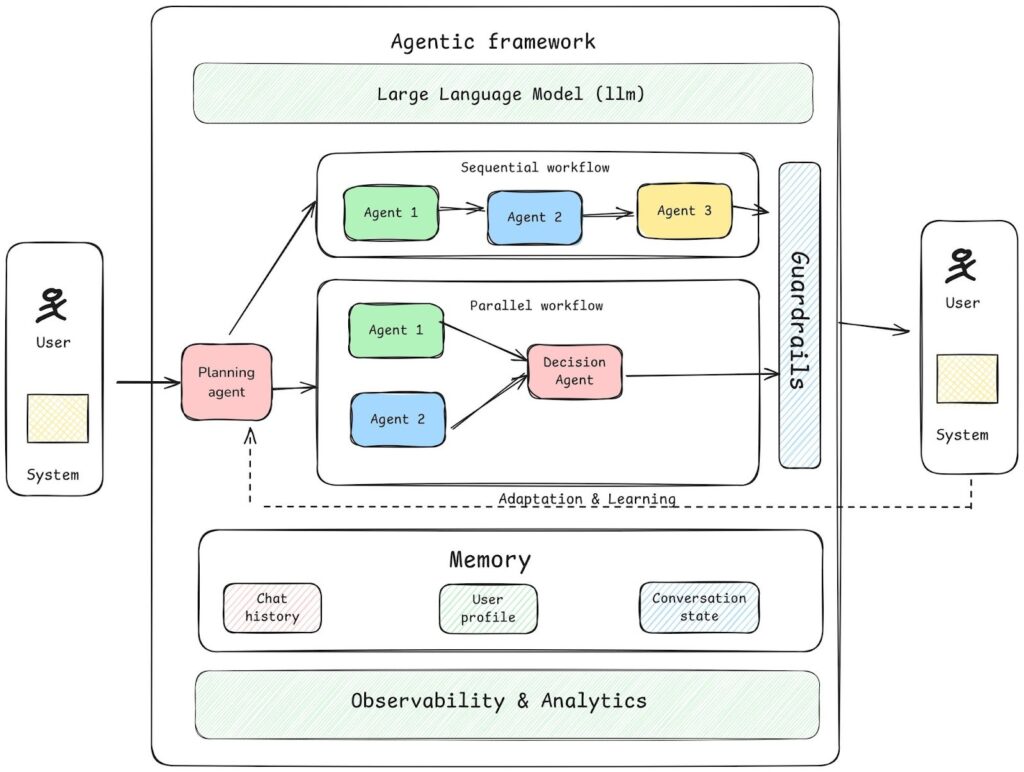
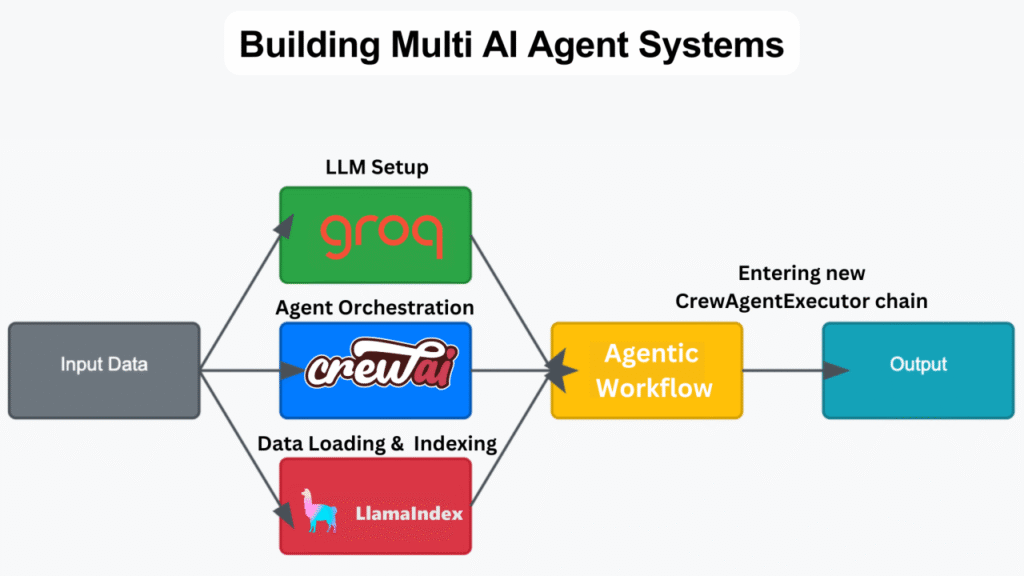
Most mature implementations follow a similar pattern:
- A goal and policy layer (this is critical)
- A planning engine that adapts in real time
- Specialized agents for SDLC tasks
- Shared memory so agents don’t act blind
- Feedback loops that actually change behavior
Miss any one of these, and autonomy turns into noise.
Where Enterprises Are Seeing Real Results
From what I’ve seen and reviewed across large systems:
- CI/CD automation reduces failed releases dramatically
- Self-healing workflows lower on-call fatigue
- Backlog prioritization agents reduce planning churn
The gains aren’t flashy. They’re operational. And they compound.
Agentic AI-Led vs Human-Led SDLC (Reality, Not Marketing)
| Area | Traditional Teams | Agentic AI-Led Teams |
| Decisions | Experience-based | Data + experience |
| Response to failure | Reactive | Predictive |
| Scaling | Add people | Add agents |
| Learning speed | Slow | Continuous |
Important point: the best setups are hybrid. Full autonomy without oversight is a bad idea. Humans still matter—just at the right altitude.
Practical Advice Before You Jump In
A few hard-earned lessons:
- Start with bounded autonomy
- Make observability non-negotiable
- Treat governance as a feature, not overhead
- Don’t automate chaos—fix processes first
Agentic AI amplifies whatever system you already have. Good or bad.
Why This Matters Now
Software complexity isn’t slowing down. Teams are already stretched.
Agentic AI in software development isn’t about replacing engineers. It’s about letting systems handle decision density so humans can focus on direction, trade-offs, and outcomes.
If you want to move from theory to execution, the next step is understanding how to apply this safely and incrementally.
FAQs
What is Agentic AI in SDLC?
It’s the use of autonomous AI agents that plan, execute, and adapt tasks across the full software lifecycle.
Is Agentic AI the same as generative AI?
No. Generative AI produces outputs. Agentic AI decides actions and owns outcomes.
Can Agentic AI run without human oversight?
Technically yes. Practically, it shouldn’t—at least not in enterprise systems.
Where should teams start?
CI/CD or testing are usually the safest entry points.
What’s the biggest risk?
Uncontrolled autonomy without governance and visibility.